

Heated Rivalry Mailbag: Answering New Hockey Fans' Questions
How does the draft work? Why are they always bumping into each other? How do they know how to come on and off the ice?

Happy Tuesday, hockey fans.
I’m sure we’ve all heard by now that our gatekept and niche beloved sport is actually having a big moment in pop culture for once. That’s right, folks, the hockey romance novel-turned-brand-new HBO Max show Heated Rivalry is taking off in its first season, and it has people all over the world asking one question: “Wait, should I GAF about the NHL?”
Here’s the synopsis of the show for the uninitiated: “Shane Hollander and Ilya Rozanov are two stars in Major League Hockey, bound by ambition, rivalry, and a magnetic pull neither of them fully understands.”
I’d been watching fans of the show ask questions about the ins and outs of real life hockey all over social media, and I finally decided to take matters into my own hands. For this week’s newsletter, they sent any and all real life hockey questions my way.
If you’re reading this and you’re new to hockey, welcome, we’d love if you stuck around! You can join the friendly group chat full of hockey fans new and old from all over the world below.

I’m one episode deep into the show, so if there’s interest I’ll follow up with “things Heated Rivalry is getting right — and is getting wrong — about real life hockey” in a few weeks.
For now, here are some of the most intriguing and/or most popular questions Heated Rivalry fans have about the NHL.
kn1ghtleys: How do I pick a team to support? There are so many that look super interesting! What I like is competitiveness and good team dynamics.
Oh, competitive? Good team dynamics? May I interest you in one (1) Vancouver Canucks? I’m just kidding and I’m sorry, we’re not starting this thing off snarky.
My first suggestion is biased since I covered this team specifically and traveled with them for years, but the Carolina Hurricanes are a great blend of competitiveness and good team dynamics. They’ve made the playoffs for seven straight seasons, each year since their ultimate competitor of a head coach Rod Brind’Amour was hired. This is the kind of coach everyone in the league wants to play for, and you’ll get a competitive game most nights. They’ve got some unfinished business as they’ve get to advance to the Cup Final in this period, so they’re still hungry.
In terms of team dynamics, Seth Jarvis on and off the ice is the player you want to look into.
Are you looking for a younger team on the up-and-up? The Anaheim Ducks are having a great season as their young core is turning years of development into a potential return to the playoffs for the first time with this group. You’ll watch some of that team chemistry develop in real time, and it won’t be too hard to catch up on the lore.
The Colorado Avalanche are currently the best team in the league, led by the most competitive player in the league: Nathan MacKinnon. They won the Cup with a similar core in 2022, but a few things have changed since then. This isn’t the “happy-go-lucky” team vibes, but it’s definitely the most competitive player and team.
hlarryious: Are there any cool, queer-friendly, supportive players who match the vibe?
Before we get into allies, there aren’t any openly gay active NHL players, and there hasn’t been one yet at the NHL level specifically. There are three prominent hockey players who have openly identified as LGBTQ+ that should be on your radar.
My friend Brock McGillis was the first openly gay professional hockey player, and he’s actually in the press with several misleading headlines regarding his opinion on Heated Rivalry as we speak. Classic. I’ll direct you to an interview we did a few years ago about hockey culture and inclusivity instead. He’s on tour right now doing great work to shift the culture.
Luke Prokop is the first openly gay NHL prospect, and he’s currently playing for the Oilers’ farm team (one level below the NHL) the Bakersfield Condors. He’s awesome and a great social media follow. A few years back, his teammates and fans showed us potential for a more inclusive future in the NHL. He could make it to the NHL and become the first openly gay NHL player in the next five years.
Harrison Browne will look familiar — he plays Connors in episode four. He played in the now defunct Premier Hockey Federation (women’s professional league) from 2015 to 2018, and was the first openly transgender professional athlete in North America upon coming out. Read about his journey and his role in the show here.
Now we’ve arrived at cool, queer-friendly, ally players. Jon Merrill of the Minnesota Wild is an active ally, and he’s in the process of launching Hockey’s Beauty Club. I checked in with him on this a few months ago and he said he’s excited to really get it off the ground soon.
Travis Dermott isn’t signed to a team right now but hasn’t officially retired. He bravely used Pride Tape on the Coyotes’ Pride Night after the league banned it.
There have been some promising social media posts from stars like MacKinnon and Brad Marchand.
There are plenty other NHL players who will tell you if a teammate came out, it wouldn’t “be a big deal,” etc., but forgive me if my definition of allyship is stricter than not actively bullying a queer person.
superfinedoom: How does the NHL draft work? Like, do players get drafted then always go right to the NHL that October or would they stay in Juniors until the next year? Is it normal for players to go right in at 18?
This is the topic I’m seeing the most confusion about across all social media platforms.
NHL draftees come from a few main places: Junior leagues (many top players come from Major Junior, comprised of the CHL, the QMJHL, and the OHL), Division I American college teams, and European leagues.
For draft eligibility, North American players have to be 18-20 years old. Europeans entering the league for the first time can be over 20 (don’t get too bogged down in this).
There are seven rounds in the draft, and 32 picks per round. Somewhere around 95-98 percent of players selected outside of the top ~15 in the first round will not yet head to the NHL. Of the top 10, it varies every year and with every era, but we’re in a high skill era right now that bodes well for the youths. So, these days about three or four players will make the team directly after getting drafted each year. We’ll get to that, but I know you’re wondering what happens to the large majority of the draftees.
Each team hosts a prospect camp after the draft, so the team’s get a good look at each drafted player and have a conversation about the future. From there, most players will either return to their original junior or college team, start a college career, or enter the NHL team’s “farm system,” and start his professional hockey career on a minor league team affiliated with the big club. Things really vary on an individual player and team-by-team basis after that. Once the club deems the player ready to start a professional career, though, the player signs a standard, three-year “entry level contract,” that often goes “both ways” (not like in Heated Rivalry), meaning the team can call the player up to the NHL and send him down to the minors as wanted for three years without “passing through waivers.”
Don’t get too bogged down in all that jargon quite yet. Once you become an NHL fan, you’re going to get wrapped up in the life and career trajectory of one of these random guys and you’ll learn all this confusing shit real fast. The emotional support prospect comes for us all.
Now, who are the special young men that actually make the NHL right off the bat? These are mostly the highly-anticipated prospects that have been on scouting reports for years. These are the best of the best at the World Juniors in the Heated Rivalry world. If you’re looking to follow an entire NHL career like this from 18 years old to infinity and beyond, Matthew Schaefer was drafted No. 1 overall in 2025. He’s been great on the Islanders in his rookie season, and he seems like a wonderful kid.
Finally, you don’t necessarily have to get drafted to play in the NHL. A fair amount of players get invited to team camps after a solid year in college or whatever and take off from there. There are also “journeymen” who work their way up in the minors for years and finally get a chance.
I don’t think Shane or Ilya would go for a journeyman.
melville50564: How do they know when to come on and off the ice? There’s so much happening
This is a fantastic question, line changes are an important part of the sport that hockey lifers sometimes take for granted.
First off, the only real “rule” to remember here is teams cannot have more than six players (usually three forwards, two defensemen, and one goaltender) on the ice at a time. So, seamless line changes are important, and players coming off the bench cannot touch the puck until there are only six players (including the goalie) from their team on the ice again, or the team gets a “too many men” penalty. This penalty happens maybe a few times per week across the league — it’s common, but for as often as line changes happen per game, it’s not that common and shouldn’t happen more than a few times per month (if that) on any individual team at the NHL level. I could sure use more “too many men” jokes between Shane and Ilya.
There are four forward lines and three defensive pairings on each team, and usually the “first” line and “first” pairing get the most minutes and the “time on ice” decreases line by line. Line combinations can change throughout the season, game by game, shift by shift, etc. There are morning skates before games and practices in between games in which reporters covering specific teams will post the line combinations for the day. We’ll keep using “line” to address the three forwards, but the process is the same for the defensive pairings. Often the whole group of five will exit at the same time, but not always, and remember there are only three defensive pairings and four lines.
So now that we know about lines, each line skates in “shifts” that vary in length depending on line, who’s out there for the other team, timing, etc.
In hockey, you’re constantly sprinting. You can only sustain this for so long, about 45 seconds at peak performance, so a shift lasts somewhere around 45 seconds to a minute and a half. In an ideal scenario, the whole line changes at an appropriate time, like when the puck is flung into the opposing end, or it is safe in the team’s offensive zone, or when the other team is changing. Players get good at anticipating this at an elite level like the NHL, and the coach might yell something like “time!” or “change!” to cue the process. Some teams run a standard rotation where the 1-4 lines rotate accordingly, on other teams the coach will yell out which specific line is up next.
Individual players will sometimes skate by the bench with a hand up indicating a need for a switch for whatever reason (could be winded, cramping, missing a stick, etc).
TL;DR?: A typical shift with five skaters and a goalie lasts around 45 seconds to 1:30. Players have a sense of when a shift is ending, and when the time is right (ideally when the puck is flung across the ice away from the team’s defensive zone), a coach will yell something to indicate the line change.
gardenstparker: What is depth scoring?
*Editor’s note: I double checked after writing this whole thing up and realized it was a New Jersey Devils fan account asking the question. You got me. Too bad you didn’t get Quinn Hughes.*
Depth scoring is the level of consistent production (goals being scored) from players who aren’t the biggest stars and/or first-liners on a team. Every team has at least one well-known star expected to lead the way for the team when it comes to scoring.
The best teams tend to have more players all over the “depth chart” who can chip in and score goals. The struggling teams tend to have more “passengers,” aka players who are simply on the ice trying not to get scored on, when the good depth scorers in that situation are more skilled at taking charge and making something good happen.
Take a look at the highest scoring 11 players through the playoff run that gave the Panthers their second straight Stanley Cup last season:
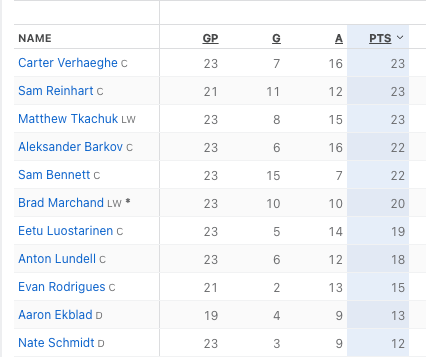
Now look at the Oilers’, the team that lost to the Panthers in the final.
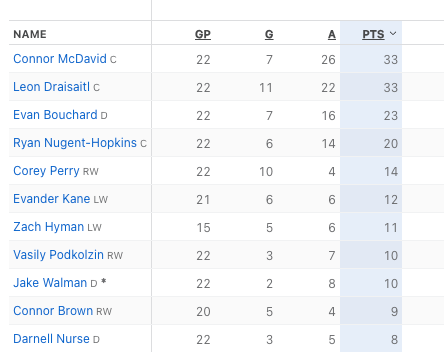
It’s not a perfect example, but you can see the scoring was more evenly dispersed among the Panthers roster. Even the best hockey player in the world (Connor McDavid) couldn’t outscore Florida’s depth, and that was pretty much the story of the series.
Depth scoring isn’t everything, but it’s often the difference between a good team and a champion when there are goals and points coming from all over the roster.
Dessysam27: Are there any real life examples of famous rivalries in the history of professional hockey that kind of parallel Shane and Ilya’s? In terms of hype, competition, media putting them against each other etc.
Let’s be clear: There are no openly queer NHL players right now, and the league has a long way to go to foster a more inclusive environment. That being said, I’ve heard the creator of the show took inspiration from the Alex Ovechkin vs. Sidney Crosby rivalry that had every single hockey fan in a chokehold throughout the 2010s. These are two generational players who were drafted around the same time, and have both spent their entire careers with the same teams in the same division. They’ve played against each other in four separate playoff series; There was even a playoff game where both got hat tricks in the same game.
They’re both in the last few years of their careers, but they’re still around and still arguably the best players on their teams most nights. Ovechkin just broke the all-time record for goals scored. He’s the greatest scorer of all time, and also a large winger who isn’t afraid to make a hit or two. Crosby’s a center, with less goals scored but more all-around production — and more Cups. (Sound familiar, anyone?)
Part of what makes this the best NHL player rivalry of all time is how different they are, and the show does a great job applying that trope in a fictionally romantic way.
Here’s a fun commercial they did a million years ago:
Spoiler alert: That was Ovechkin pretending to be Crosby.
spobbos: how TF AM I SUPPOSED TO ICE SKATE why is it so hard help
Bend your knees! Learn how to fall properly and don’t be afraid of it, then keep getting those reps in when you can safely fall. Seriously, watch videos from coaches on how to fall. People will tell you to hold on to the wall or an infamous milk crate, but I say the quicker you learn how to balance, the quicker you learn how to skate, and you can’t do that without falling…or falling in love in secret for a decade!
BigtTonyp: Please explain goaltender interference.
Do I look like God to you?
A serious tip for any hockey beginners reading this: Literally no one knows what goalie interference actually is because the rule itself is vauge, and of course it’s good ole rule 69.
No NHL coach, no player, no fan will be able to look at a play and definitively tell you if it’s goalie interference or not. Don’t let anyone gaslight you on this. Better yet, gaslight them right back.
nickjmb: Do teams actually play multiple times per week? In ep 3 Scott played Ilya in Boston and the next night he’s playing against Shane in Montreal
Yes! A few times per month they’ll even have the dreaded “back-to-back,” which is — you guessed it — two games in two days.
There are 82 games in the regular season (this is getting bumped up to 84 next year, when a new set of rules kicks in), and the regular season spans from October to April. With some breaks like the upcoming Olympic break and the All-Star break, they’ve gotta squeeze all these games in somewhere.
As opposed to a sport like baseball, where teams will typically set up shop in one city for a long weekend to play a series, NHL teams have a series of trips and homestands varying in length.
I used to travel with the Canes, so I’ll use their schedule as an example. There’s typically a big “West Coast road trip” lasting almost two weeks, where you travel to all the California clubs, Vegas, and maybe an outlier out there like Denver. There are Canadian road trips where the team rips through the furthest side of Canada. There are also one- or two-game trips sprinkled in as the schedule accommodates all 32 teams. There are mom and dad trips where the moms or dads (often alternating year by year) join the team, usually on a longer, sunnier trip.
It’s truly a whirlwind, but remember: Your typical skater averages somewhere around 20 minutes per game, and no one (save for the top few best defensemen in the league) is averaging more than 25 minutes per game except the goaltender. Goaltenders rarely if ever play back to back games, hence the need for a “backup goalie.”
dried_shwimpies: I see that there are a lot of heated altercations on ice, like literal throwing of punches. How is that allowed?
It just is.
phailone: Since the game is very physical like players constantly bumping into eachother, what counts as foul or when does the whistle blow? Is there a limit or height to which the players can swing their stick?
There is a limit or height to which the players can swing their stick. The rule is called high-sticking, and get this: It’s a two-minute penalty if a player’s stick rises above shoulder length and hits an opponent’s head or neck, but it’s a four-minute penalty if all of this happens and there’s visible blood as a result.
Hockey!
As for the rest of your question, the continued legality of certain hits has been a discussion amongst fans and media for over a decade now that we’re becoming more aware of CTE. Well, everyone is aware of CTE except league commissioner Gary Bettman, who refuses to acknowledge a link between hockey and CTE despite several tragic stories and evidence. Any hit to the head is technically illegal if it meets two criteria: The head is the main point of contact, and that contact is avoidable.
There are some dangerous-looking hits that are technically legal according to the rulebook, and there are dangerous-looking hits that are certainly illegal according to the rulebook.
A legal hit, most commonly a body check, must target a player with the puck. You cannot check a player without the puck, you cannot target the head or hit a defenseless player from behind, you cannot hit a player into the boards, and you can’t start with your elbow or knee.
As for punching each other in the face, again, go right ahead!
aforsyth03: Not new but I still have the same question after a decade as a Canucks fan: what the fuck
And that’s a perfect sentiment as we wrap this thing up. Got any more questions? Drop them in the comments.
Sara. I was at the Bruins game last night. Morgan Geekie. I mean the name alone. Hockey name hall of fame?
i’m so glad to see you taking advantage of the hr hype sara, hope this brings new readers to your lovely writing!!! loved you on the canes beat ♥️ you probs made me a lifelong canes fan (and would LOVE the post-show piece)